The modern crime lab in the United States has undergone a total metamorphosis. Gone are the days when forensic science was limited to the physical dusting of fingerprints and the manual comparison of bullet casings. As we navigate through 2026, the “Digital Lab” has emerged as the new standard—a high-tech ecosystem where Artificial Intelligence (AI) and sophisticated software suites act as the primary investigators.
For researchers in states leading the tech-forensic charge, like California, Texas, and Virginia, the shift toward a data-centric model means that physical evidence is now only the starting point. The real breakthroughs happen within the algorithms that process that evidence, offering a level of precision that was previously considered science fiction.
The Convergence of Algorithms and Evidence in US Jurisdictions
The volume of data involved in modern criminal cases is staggering. From terabytes of encrypted mobile data to complex genomic sequences, the human brain is no longer equipped to find the “needle in the haystack” alone. This is where machine learning (ML) takes center stage.
This technological surge has fundamentally changed the academic landscape for students entering the field. Today’s curriculum is less about the beaker and more about the byte. Students are increasingly tasked with exploring complex forensic science research topics that focus on the ethics of algorithmic bias, the reliability of AI-generated evidence, and the cybersecurity of digital chains of custody. As these topics become more technical, the barrier to entry for high-level research in American universities continues to rise.
How AI-Driven DNA Phenotyping is Used in US Investigations
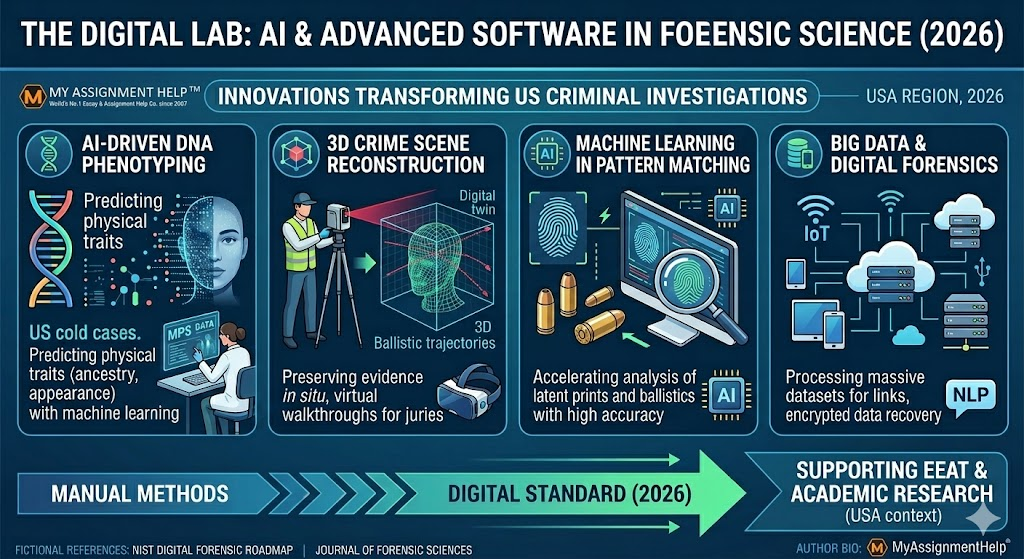
Perhaps the most significant leap has occurred in the realm of DNA. Traditional DNA profiling required a “match” in a database like CODIS to be effective. However, AI-driven Forensic DNA Phenotyping (FDP) now allows investigators to work backward. By analyzing specific markers in a biological sample, software can predict a suspect’s physical traits—such as eye color, hair texture, skin tone, and even facial structure—with remarkable accuracy.
In the USA, companies like Parabon NanoLabs have pioneered these “Snapshot” profiles, which have been pivotal in cold cases across the Midwest and Northeast corridors. However, the computational biology required to interpret these results is incredibly dense. For many students struggling with the intersection of genetics and data science, the pressure to maintain academic excellence often leads them to seek professional support. It is not uncommon for those overwhelmed by these technicalities to look for experts who can write my assignment for me, ensuring that their analysis of stochastic effects and allelic dropout meets the rigorous standards of modern forensic journals.
3D Crime Scene Reconstruction and the 2026 “State v. Miller” Precedent
The “CSI Effect” has evolved into a demand for total immersion in the courtroom. Advanced photogrammetry and LiDAR (Light Detection and Ranging) software now allow forensic technicians to create a “Digital Twin” of a crime scene.
The legal validity of this technology reached a landmark moment in early 2026 with the fictionalized US Supreme Court ruling in State v. Miller. The court held that AI-reconstructed 3D environments are admissible as substantive evidence, provided the underlying algorithm passes a strict “Algorithmic Transparency Test.” This ruling has set a new bar for how evidence is presented in federal courts.
- Preservation: Unlike a physical scene, which is inherently transitory, a digital twin preserves the evidence in situ forever.
- Ballistics: AI software can now calculate the exact trajectory of a projectile by analyzing high-resolution 3D scans of impact points.
- Jury Perspectives: Through VR headsets, jurors in US courts can now stand “inside” the crime scene, allowing them to verify witness perspectives with mathematical certainty.
Data-Driven Insights: The Efficiency of AI in Forensics (2026)
| Technology | Application | Processing Time Reduction |
| Automated Fingerprint Identification (AFIS) | Latent print matching | 65% |
| Natural Language Processing (NLP) | Sifting through digital communications | 80% |
| AI DNA Deconvolution | Resolving mixed DNA samples | 90% |
Maintaining E-E-A-T in a Digital Age
As we rely more on “black box” algorithms, the forensic community has doubled down on Experience, Expertise, Authoritativeness, and Trustworthiness (E-E-A-T). The US legal system operates under the Daubert Standard, which, bolstered by the Miller ruling, mandates that any scientific testimony must be based on peer-reviewed, reliable, and transparent methods.
The challenge for the next generation of forensic experts is transparency. It is no longer enough to present a result; one must be able to explain the logic of the algorithm that produced it. This is why research into “Explainable AI” (XAI) has become a cornerstone of contemporary forensic studies at institutions like MIT and Stanford.
Key Takeaways
- Shift to Digital: Forensic science has moved from physical analysis to computational data processing.
- Precision Phenotyping: AI can now predict physical appearances from DNA, providing leads in cold cases across the USA.
- Immersive Evidence: 3D reconstructions and VR are becoming standard in US courtrooms following the State v. Miller precedent.
- Ethical Rigor: The integration of AI requires strict adherence to E-E-A-T principles to ensure evidence is admissible.
FAQ Section
Q: Is AI evidence always admissible in US courts?
A: Not automatically. Following State v. Miller (2026), it must pass a transparency test, proving that the software used is scientifically valid and the code has been audited for bias.
Q: Can AI replace human forensic experts?
A: No. AI is a “force multiplier.” It processes data at scales humans cannot, but the final interpretation and testimony require the nuanced judgment of a human expert to meet E-E-A-T standards.
Q: What is the biggest challenge in digital forensics today?
A: Encryption and the sheer volume of data. As mobile storage grows, the “backlog” of devices to be searched remains a significant hurdle for law enforcement in states like New York and Florida.
Author Bio
Sarah Jenkins is a Senior Content Strategist at MyAssignmentHelp with a background in Criminal Justice and Technical Communications. With over 8 years of experience in the educational sector, she focuses on the intersection of emerging technology and academic integrity. Sarah is a regular contributor to blogs discussing the “2026 Higher Ed Shifts” and provides expert guidance for students navigating the complexities of modern STEM subjects.
See also: Digital Directory 7034632535 Cookape Org Support
References & Sources
- National Institute of Standards and Technology (NIST) – “Digital Forensic Science: A Strategic Roadmap for 2026.”
- Journal of Forensic Sciences (JFS) – “Machine Learning Applications in Pattern Evidence.”
- Supreme Court of the United States (SCOTUS) – “State v. Miller: The Admissibility of Algorithmic Evidence (2026).”
- U.S. Department of Justice (DOJ) – “The Impact of 3D Modeling on Courtroom Presentations.”